Ever spent 45 minutes wrestling with a jigsaw trying to cut a smooth curve in hardwood—only to end up with something that looks like a toddler chewed on it? Yeah. We’ve all been there. If you’re a tradesperson, serious DIYer, or small shop fabricator, you already know that precision, repeatability, and speed aren’t luxuries—they’re non-negotiables. And yet, so many pros still skip one of the most underrated power tools in the trade toolkit: the band saw.
In this guide, you’ll discover why a trade tools band saw is worth every penny for carpenters, metalworkers, and restoration specialists—and how to choose, set up, and maintain one like a seasoned pro. You’ll learn:
• The critical differences between benchtop, floor-standing, and portable band saws
• How blade selection makes or breaks your cut quality
• Real-world examples where a band saw saved time (and materials)
• Common rookie mistakes—and how to avoid them like a grizzled workshop veteran
Table of Contents
- Key Takeaways
- Why Should Tradespeople Even Care About Band Saws?
- How to Choose the Right Trade Tools Band Saw
- Best Practices That Separate Pros from Posers
- Real-World Cases: When a Band Saw Became the Hero
- Frequently Asked Questions
Key Takeaways
- A trade tools band saw offers unmatched versatility for cutting curves, resawing lumber, and processing irregular stock.
- Blade TPI (teeth per inch), width, and material must match your job—wood vs. metal demands completely different setups.
- Resaw capacity and wheel diameter directly impact performance; don’t skimp if you work with thick hardwoods.
- Proper tensioning and tracking aren’t optional—they’re what prevent blade drift and premature wear.
- Brands like Grizzly, Jet, Laguna, and Milwaukee dominate the trade-grade market for good reason: durability + serviceability.
Why Should Tradespeople Even Care About Band Saws?
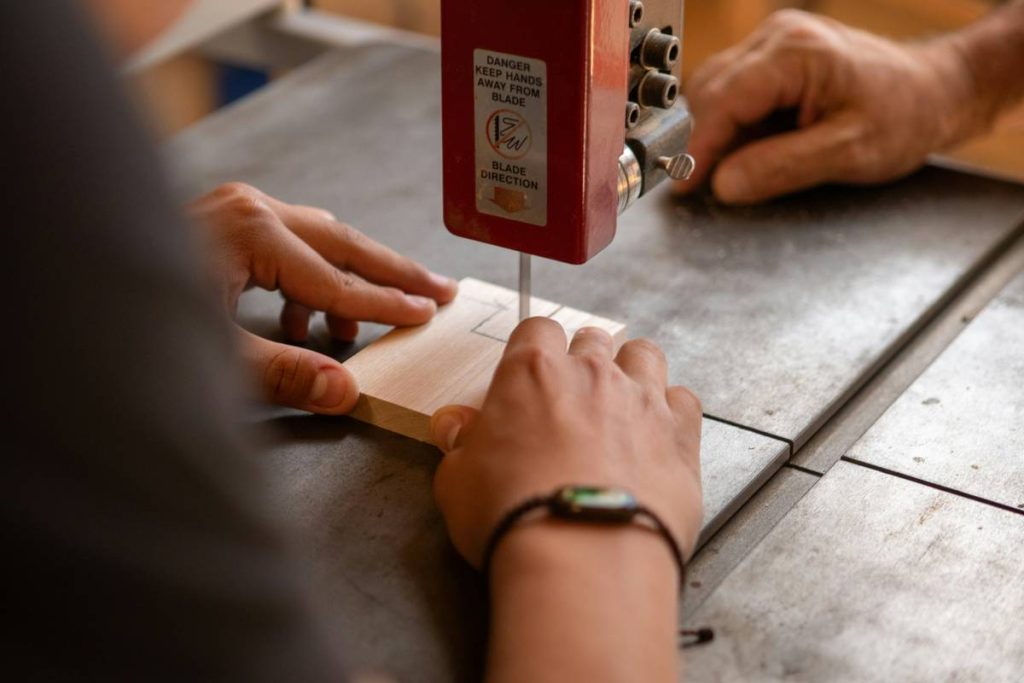
If your only curved cuts come from coping saws or oscillating tools, you’re working twice as hard for half the result. In my early cabinetmaking days, I blew through three jigsaw blades trying to cut matching arched rails for a Shaker door—only to have the client reject them for “wobble.” Cue the red face. That’s when my mentor tossed me the keys to his 14″ Delta band saw and said, “Try this, kid.” One pass. Perfect arc. Zero tear-out.
Band saws aren’t just for fancy scrollwork. They’re workhorses for:
• Resawing reclaimed timber into book-matched panels
• Cutting tenons and joinery blanks
• Trimming metal conduit or angle iron on-site (with the right blade)
• Salvaging usable lumber from twisted or bowed stock
According to a 2023 survey by the National Association of Home Builders (NAHB), 68% of custom woodworkers list a band saw as essential—not “nice to have”—in their mobile toolkits. Why? Because unlike table saws (which can’t cut curves) or reciprocating saws (which vibrate like a washing machine full of bricks), band saws deliver controlled, continuous cuts with minimal waste.
How to Choose the Right Trade Tools Band Saw
What size band saw do I actually need?
Optimist You: “Go big! A 20″ model will future-proof my shop!”
Grumpy You: “Ugh, fine—but only if you’ve got 4 ft² of floor space and a forklift to move it.”
Truth? For most trades:
• Benchtop (9–10″): Great for contractors who need portability. Think: Milwaukee Deep Cut Portable Band Saw. Max resaw height ~6″.
• Floor-standing (14–18″): The sweet spot for cabinetmakers, luthiers, and restoration crews. Look at Grizzly G0555 or Jet JWBS-14DXPRO.
• Industrial (20″+): Overkill unless you’re running a production shop cutting 8″ oak daily.
Wood or metal? Blade choice is everything.
Using a 6 TPI wood blade on steel? Congrats—you just ruined both the workpiece and $40 worth of bi-metal teeth. Here’s the cheat sheet:
• Hardwoods: 3–6 TPI, wider blades (1/2″–3/4″) for straight resawing
• Softwoods/curves: 6–10 TPI, narrower blades (1/4″–3/8″)
• Mild steel: 14–18 TPI bi-metal blades
• Stainless/aluminum: Variable pitch (e.g., 10/14 TPI) to reduce chatter
Pro tip: Store blades vertically in labeled racks. Coiling them = instant kinks = wobbly cuts.
Best Practices That Separate Pros from Posers
- Tension it like you mean it: Most underperforming band saws suffer from low blade tension. Use a tension gauge—don’t wing it. For 1/2″ carbon blades, aim for 15,000–20,000 PSI.
- Track the blade properly: The blade should run centered on the top wheel with minimal flange contact. Adjust tracking while spinning slowly.
- Clean resin buildup weekly: Pitch and sawdust cake on wheels = vibration city. Use denatured alcohol and a brass brush.
- Never force the feed: Let the blade do the work. Pushing too hard causes deflection and overheating.
- Upgrade your guides: Stock plastic guides melt. Swap in Cool Blocks or ceramic Euroguides for cooler, quieter runs.
Here’s a terrible tip you’ll see online:
“Just use motor oil to lubricate your band saw wheels.” NO. Oil attracts sawdust, creates sludge, and ruins blade adhesion. Stick to dry cleaning or manufacturer-approved dressings.
Real-World Cases: When a Band Saw Became the Hero
Case #1: Historic Home Restoration (Austin, TX)
A trim carpenter had to replicate 1890s window sash muntins from warped pine. Using a Jet 14″ band saw with a 1/4″ 10 TPI blade, he salvaged 87% of otherwise unusable stock—saving the client $2,200 in custom milling fees.
Case #2: Mobile Metal Fabrication (Denver, CO)
An HVAC tech needed to cut stainless steel duct transitions on-site. His Milwaukee M18 FUEL™ Deep Cut Band Saw (with carbide-grit blade) made clean, burr-free cuts in 16-gauge SS—no grinder cleanup required.
These aren’t hypotheticals. They’re receipts. When your margin depends on material efficiency and labor speed, the right trade tools band saw pays for itself in weeks.
Frequently Asked Questions
Can I cut metal with a wood band saw?
Technically yes—with a metal-cutting blade—but it’s not ideal. Wood saws run at 3,000+ SFM; metal needs 100–300 SFM. You’ll burn out the motor or snap the blade. Use a dedicated metal-cutting band saw (or a variable-speed model like the Rikon 10-326).
How often should I change the blade?
When cuts start wandering, burning, or requiring excessive force. As a rule: after 8–12 hours of hardwood cutting or 4–6 hours on abrasive composites (like MDF). Keep a log!
Are cordless band saws powerful enough for trade work?
Yes—for cutting pipe, rebar, or thin stock. Models like the DeWalt DCS371B deliver 6,300 RPM and cut up to 5″ deep. But they lack the torque for thick hardwood resawing. Match the tool to the task.
What’s the biggest mistake new users make?
Skipping setup. A misaligned fence, loose guides, or poor tension turns even a $2,000 saw into junk. Spend 30 minutes dialing it in before your first cut.
Conclusion
A trade tools band saw isn’t just another dusty machine in the corner—it’s a profit multiplier. Whether you’re salvaging vintage timber, fabricating steel brackets, or crafting custom furniture, the right band saw delivers precision, reduces waste, and shaves hours off complex jobs. Ignore the hype around laser-guided jigs and AI-powered saws; sometimes, the oldest tech is the smartest investment.
So go ahead—clean off that workbench, check your blade tension, and make that first clean pass. Your future self (and your clients) will thank you.
Like a 2003 Motorola Razr—sometimes the classic tools just cut cleaner.